
What Is an Electronic Logging Device (ELD)? FMCSA Rules, How It Works & 2026 Compliance Guide for Drivers & Fleets
What Is an Electronic Logging Device (ELD)?
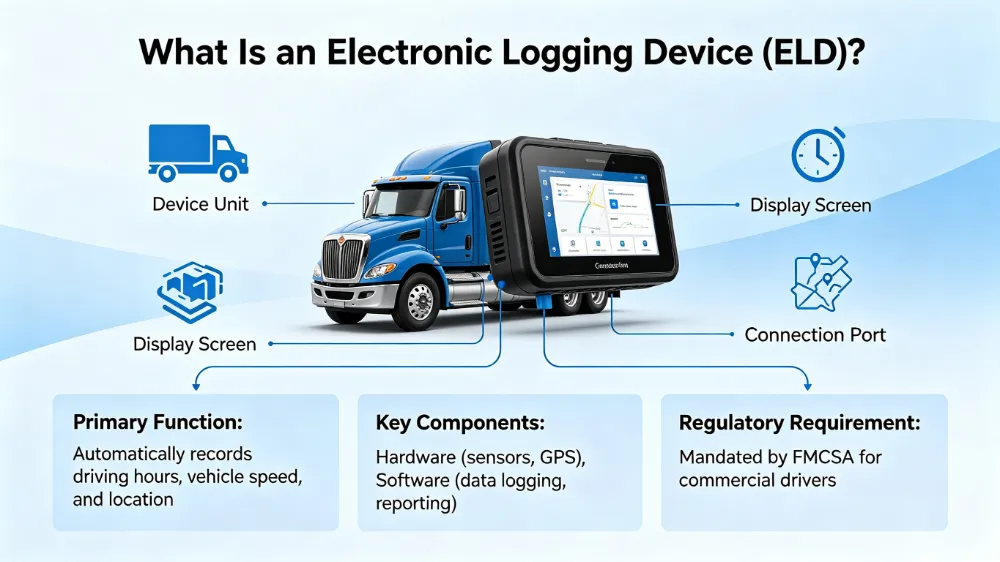
An Electronic Logging Device (ELD) is a synchronized electronic system installed in commercial motor vehicles (CMVs) that automatically records a driver’s duty status, driving time, and other critical data to ensure compliance with federal Hours of Service (HOS) regulations. Mandated by the Federal Motor Carrier Safety Administration (FMCSA), ELDs replaced manual paper logs for most commercial truck and bus drivers to improve accuracy, reduce fatigue-related risks, and streamline enforcement.
ELD Full Name and Basic Meaning
ELD stands for Electronic Logging Device. It is hardware and software that connects directly to a vehicle’s engine to capture real-time operational data without relying on manual driver input for core records. The goal is simple yet critical: create a tamper-resistant, accurate record of duty status (RODS) that both drivers and safety officials can trust.
ELD Hardware Composition
A typical ELD includes a main processing unit, GPS antenna for location tracking, cellular or Wi-Fi connectivity for data transfer, a driver-facing display or app interface, and secure connection ports (usually via the vehicle’s OBD-II or J1939 engine data bus). Many modern ELDs integrate with tablets or smartphones, but the core unit must remain engine-synchronized. For fleets, ELDs often link to broader telematics platforms for real-time fleet visibility.
ELD vs. Traditional Paper Logs
Paper logs required drivers to manually record every change in duty status, leading to errors, omissions, or intentional falsification. ELDs automate most of this process, reducing administrative time from an average of 6 minutes per log entry (pre-ELD) to about 2.5 minutes or less. They also minimize supporting documents from unlimited to a maximum of eight, cutting paperwork burden significantly for both solo drivers and large fleets.
How an ELD Works
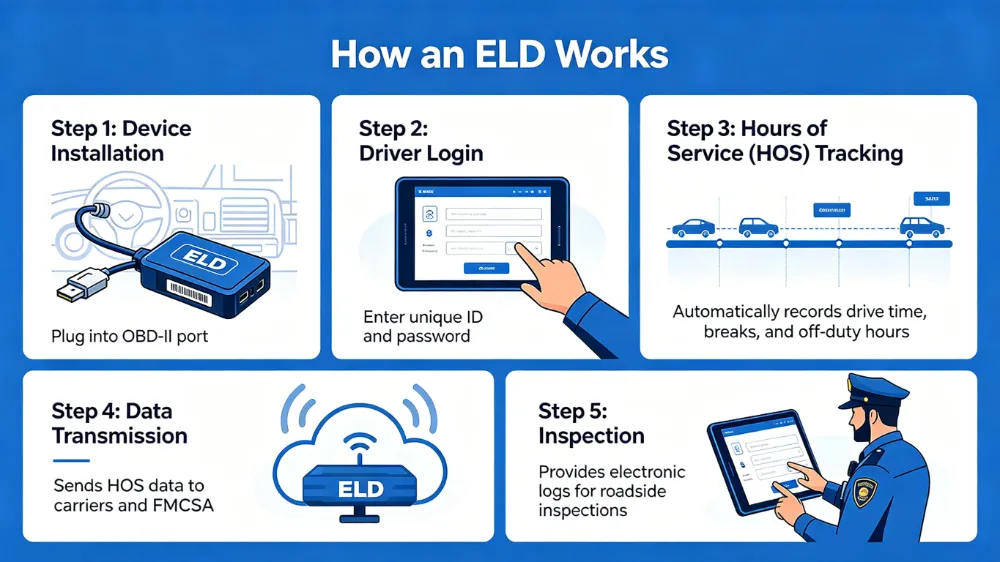
ELDs operate by continuously syncing with the vehicle’s engine control module (ECM) to capture objective data, ensuring records reflect actual vehicle activity rather than driver memory or estimates.
How an ELD Connects to the Vehicle Engine
The device connects via the truck’s diagnostic port or engine bus (typically J1939 for heavy-duty vehicles). Once installed and configured, it automatically detects key events: engine power-on, vehicle motion above a low speed threshold (as low as 5 mph in some configurations), and ignition status. This engine synchronization is mandatory and cannot be bypassed without triggering a malfunction alert.
Data Automatically Recorded by ELD
ELDs capture and store the following core elements in real time:
- Driving time and miles driven
- Vehicle location via GPS (recorded at least once per hour or upon duty status change)
- Engine hours and vehicle speed
- Date and time synchronized to Coordinated Universal Time (UTC)
- Driver’s duty status: Driving, On-Duty Not Driving, Off-Duty, or Sleeper Berth
- Vehicle identification and motor carrier information
- Malfunction or diagnostic events
This data generates a complete electronic Record of Duty Status (eRODS) that drivers can view on the device and officials can inspect roadside or via electronic transfer.
ELD Synchronization with Vehicle ECM/OBD
Synchronization occurs automatically and continuously. The ELD monitors engine power, vehicle movement, and accumulated miles. If the connection is lost or data becomes inconsistent, the device logs a malfunction and requires the driver to note it. For drivers, this means minimal manual intervention during normal operation. For fleet managers, it provides reliable data for compliance audits and performance analysis.
Main Functions of an ELD
ELDs go beyond simple time tracking to support full HOS compliance and operational efficiency.
Automatic Recording of Hours of Service (HOS)
ELDs enforce FMCSA’s core HOS limits by automatically accumulating driving and on-duty time:
- 11-hour driving limit (property-carrying vehicles) after 10 consecutive hours off duty
- 14-hour on-duty window (driving must stop after the 14th hour)
- 30-minute break requirement after 8 cumulative hours of driving/on-duty time
- 60/70-hour weekly on-duty limits (7 or 8 consecutive days)
As of 2026, these core limits remain unchanged, though FMCSA continues pilot programs testing flexible sleeper berth and split-duty options to give drivers more scheduling flexibility without compromising safety.
Recording Driver Duty Status (RODS)
The ELD supports four standard duty statuses and automatically switches to “Driving” when the vehicle moves. Drivers can manually select or edit other statuses (with annotations explaining changes), but the system retains original entries for audit trails. This creates a clear, chronological RODS that officials can review quickly using FMCSA’s eRODS software.
Real-Time Data Collection and Monitoring
ELDs provide instant visibility into current HOS remaining, upcoming required breaks, and any duty status anomalies. Fleet managers benefit from dashboard integration that flags potential violations before they occur, enabling proactive dispatch adjustments. Drivers receive alerts on the device or paired app, helping them plan rest stops effectively.
Data Transfer and Printing Capabilities
During roadside inspections, drivers must present ELD data electronically (via Bluetooth, USB, or email) or as a printable report. Compliant ELDs support standardized data files that upload directly to FMCSA systems. This capability has dramatically reduced inspection times compared to deciphering handwritten paper logs.
ELD Regulations and Compliance Requirements
FMCSA’s ELD rule, stemming from the 2012 MAP-21 Act, became fully enforceable years ago, but 2026 enforcement is stricter than ever due to ongoing device audits and data integrity focus.
FMCSA/DOT Mandate
Most drivers of commercial motor vehicles who are required to keep Records of Duty Status must use a self-certified, FMCSA-registered ELD. As of April 2026, FMCSA actively removes non-compliant devices—more than 56 devices have been revoked since January 2025 alone. Using a revoked device after the grace period (typically 60 days) results in the vehicle being treated as operating without any ELD.
Penalties in 2026 can reach up to $15,691 per violation for carriers, with drivers facing out-of-service orders and fines. Fleets risk higher insurance premiums and CSA scores if non-compliance patterns emerge.
Background of the ELD Rule (MAP-21)
Congress directed FMCSA to require ELDs to improve HOS compliance and reduce fatigue-related crashes. The final rule was published in 2015, with phased implementation ending in full enforcement by late 2019. The regulation (49 CFR Part 395, Subpart B) sets technical specifications for data recording, security, and transfer.
Who Must Use an ELD?
The mandate applies to nearly all drivers required to maintain RODS, including long-haul and regional truck drivers, many local operators, and bus drivers. Exemptions exist for:
- Short-haul drivers (within 150 air miles, limited on-duty time)
- Vehicles manufactured before 2000 (with certain conditions)
- Drivers using paper logs for 8 or fewer days in a 30-day period (limited exception)
Owner-operators and small fleets are especially affected, as they often transitioned later and must now ensure devices remain on the current registered list.
ELD vs. AOBRD Differences
Automatic On-Board Recording Devices (AOBRDs) were an earlier technology allowed under 1988 rules. Key differences include:
- Engine synchronization: ELDs require stricter, more comprehensive integration
- Data transfer: ELDs support electronic transmission to FMCSA; AOBRDs generally do not
- Edits and annotations: ELDs allow driver notes while preserving originals
- Malfunction handling: More robust requirements for ELDs
- Registration: Only ELDs appear on FMCSA’s official list
Grandfathered AOBRDs were phased out years ago. In 2026, only properly registered ELDs are acceptable. Using a revoked or non-listed device triggers the same penalties as having no ELD at all.
ELD Certification Standards
Devices must be self-certified by manufacturers against FMCSA technical specifications and listed on the official registry at eld.fmcsa.dot.gov/List. Carriers should check this list regularly—FMCSA removed 14 devices in March 2026, 9 in February, and continues monthly reviews. Drivers and fleet managers must replace revoked devices within the specified deadline (e.g., June 2, 2026 for the most recent HERO ELD removal) or revert to paper logs temporarily.
Purpose and Benefits of Using an ELD
Improving Road Safety
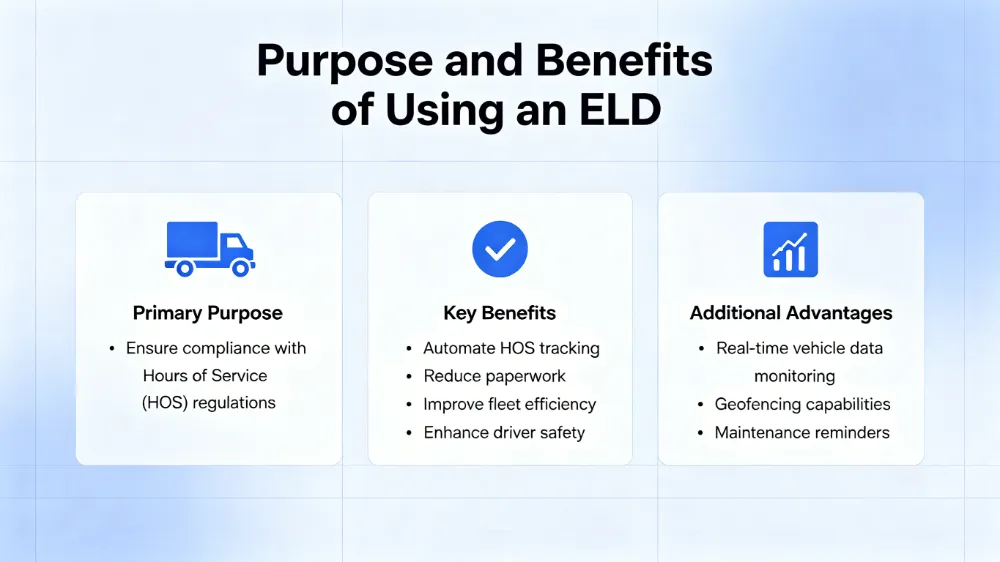
FMCSA’s original analysis projected that widespread ELD use would avoid approximately 1,844 crashes, 562 injuries, and 26 fatalities annually by better enforcing HOS rules and reducing fatigue. Post-mandate data shows significant HOS violation reductions: from about 1.19% of inspections in late 2017 to roughly 0.77% by 2021, with continued improvements noted in subsequent years. While some independent studies found mixed or neutral effects on overall crash rates, the consensus across enforcement data is clearer HOS adherence, which lowers fatigue risk for long-haul drivers and helps fleet safety managers maintain lower CSA scores.
For individual drivers, accurate automatic tracking reduces pressure to “push hours” or falsify logs, allowing better rest planning and lower stress during long shifts.
Increasing Record Accuracy and Efficiency
ELDs eliminate handwriting errors and reduce the administrative burden. Pre-ELD, carriers spent millions annually on paper logs and storage. Post-ELD, recordkeeping costs dropped substantially (estimated annual industry savings in the tens of millions). Drivers spend less time at the end of shifts filling logs, and fleets gain real-time visibility for better route planning and load assignment.
Simplifying Compliance Management and Inspections
Roadside officers can review standardized eRODS files quickly, often without entering the cab. This speeds up inspections and reduces downtime. For fleets, centralized data upload during audits replaces boxes of paper records. In 2026, with tighter enforcement and digital verification priorities, compliant ELDs help avoid out-of-service orders that can cost drivers and carriers significant revenue.
Benefits for Fleet Management
Fleet operators integrate ELD data with telematics for fuel monitoring, idle-time reduction, predictive maintenance, and performance coaching. Real-time HOS visibility allows dispatchers to optimize schedules, reduce overtime violations, and improve driver retention by demonstrating fair workload distribution. Small carriers and owner-operators particularly benefit from affordable cloud-based ELD solutions that scale with growth.
Frequently Asked Questions (FAQs)
What is the difference between ELD and electronic logging device?
There is no difference—ELD is the official FMCSA term for any compliant electronic logging device.
Do all commercial vehicles need an ELD?
No. Short-haul exceptions, pre-2000 engine vehicles (with restrictions), and certain limited-use scenarios are exempt. Most over-the-road and many regional drivers must use one. Always verify your operation against current FMCSA guidance.
How does an ELD help drivers and fleets avoid fines?
By automatically enforcing HOS limits and producing auditable records, ELDs reduce violation rates (historically down over 40-50% in many segments). They also enable quick, accurate responses during inspections, avoiding citations for missing or falsified logs.
What should drivers and fleets consider when choosing an ELD in 2026?
Select only devices currently listed on the FMCSA Registered Devices list. Evaluate ease of use, mobile app quality, customer support, data security, integration with existing fleet software, and cost (including subscription fees). Check recent revocation notices—avoid any manufacturer with recent removals. Test for reliable GPS, cellular coverage in your operating areas, and clear alerts to prevent unintentional violations.
How often should fleets audit their ELD compliance?
At minimum, monthly checks against the FMCSA list, plus driver training refreshers and data reviews for anomalies. With over 56 devices revoked since early 2025 and ongoing enforcement, proactive monitoring prevents costly surprises.
7 inch rugged tablet Android,android 14 tablet
相关推荐内容
Latest Content
- How to Choose Rugged Tablets for School Buses?
- School Bus MDT Guide – Rugged Mobile Data Terminals for Student Transportation
- What Are the Best 8-Inch Rugged Tablets for Construction, Field Work, and Outdoor Use in 2026?
- CAN Bus Integration for Fleet Tablets: A Practical System Integrator's Guide
- Bedside Terminal Solutions for Modern Healthcare Facilities
Hot product
- WMT6UQ: 6-Inch 4G Android 12 Wireless Carplay Navigator Motorcycle PND
- WT10RX: 10.1 inch rugged tablet,10.1″ sunlight-readable display,10.1" ip67 rugged tablet
- WT10MX: 10.1 inch rugged tablet 12,000 mAh,10.1″ IPS display Rugged IP65 design
- WT08Q9Y: 8 inch 10000mAh long battery rugged tablet,1000-nit rugged tablet,
- WT08M8Y: 8 inch Android 14,700-nits rugged tablet