The 2026 Definitive Guide to Rugged Vehicle-Mounted Tablets: Selection, Integration, and Deployment
Introduction: The Critical Role of In-Vehicle Computing
In the demanding environments where fleet vehicles operate—whether responding to emergencies, delivering critical freight, or maintaining infrastructure—consumer-grade tablets fail. They fail from vibration, from temperature extremes, from dust infiltration, and from the constant jostling of vehicle operation. When a device fails in the field, the consequences extend beyond hardware replacement costs: dispatchers lose visibility, drivers lose guidance, and operations grind to a halt.
The rugged vehicle-mounted tablet has evolved into the indispensable command center for modern mobile operations. Unlike handheld devices or consumer tablets pressed into service, these purpose-built in-vehicle rugged tablets are engineered to withstand the harshest conditions while providing reliable computing power, precise positioning, and seamless integration with vehicle systems.
For fleet managers, public safety procurement officers, logistics IT directors, military logistics personnel, and field service operations leaders, selecting the right mobile data terminal represents a strategic decision with long-term operational and financial implications. A poorly chosen system results in frequent replacements, frustrated operators, and integration headaches. A well-chosen system delivers years of reliable service, enhanced safety, and measurable productivity gains.
This guide provides a comprehensive framework for evaluating and selecting rugged vehicle-mounted tablets. Drawing on military testing standards, industry best practices, and real-world deployment experience, it addresses every aspect of the selection process—from environmental specifications to mounting solutions, from power management to telematics integration.
1. Understanding the Rugged Vehicle-Mounted Tablet Category
1.1 What Defines a Rugged Vehicle-Mounted Tablet?
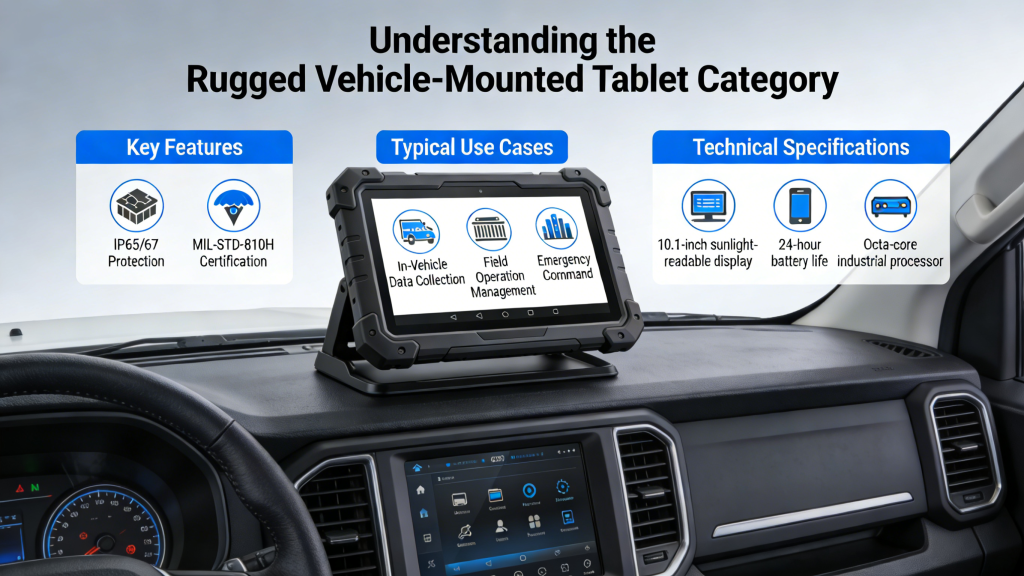
A rugged vehicle-mounted tablet is a purpose-built computing device designed for permanent or semi-permanent installation in vehicles operating in demanding environments. Unlike consumer tablets, which are designed for controlled indoor use, rugged vehicle tablets are engineered to withstand:
- Continuous vibration and shock from vehicle operation
- Extreme temperature ranges from arctic cold to desert heat
- Exposure to dust, moisture, and other environmental contaminants
- Intense sunlight requiring high-brightness displays
- Power fluctuations from vehicle electrical systems
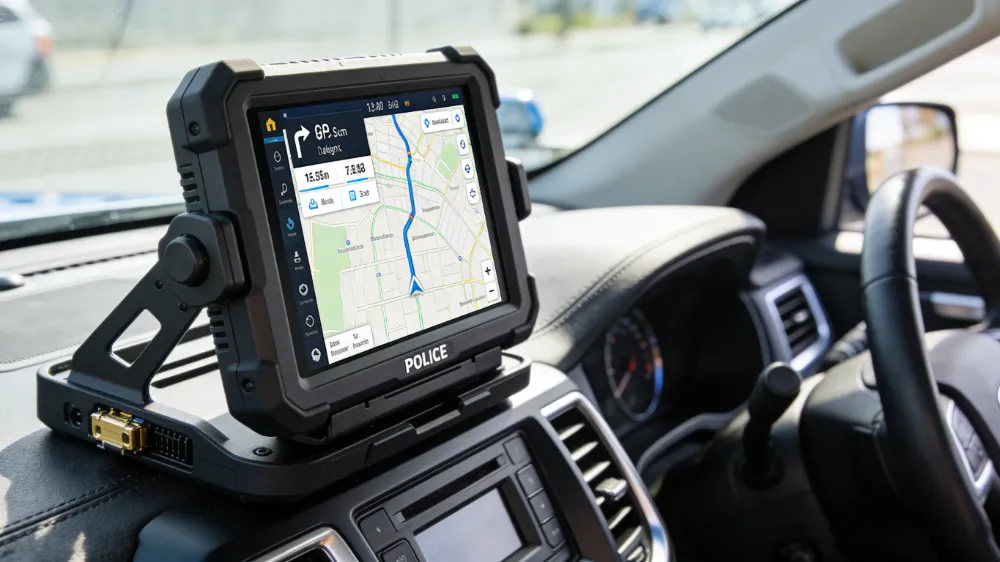
These devices typically incorporate vehicle dock tablet mounting solutions that secure the device during vehicle operation while providing power, data connectivity, and integration with vehicle systems.
1.2 Vehicle-Mounted Computer vs. Handheld Rugged Tablet
Organizations often face a fundamental choice: vehicle-mounted computer vs handheld rugged tablet. Each form factor serves distinct use cases:
Vehicle-Mounted Computers
- Permanently installed in the vehicle
- Larger screens (8 to 15 inches) optimized for viewing while driving
- Integrated directly with vehicle power and systems
- Ideal for primary in-vehicle use where operators remain in the vehicle
Handheld Rugged Tablets
- Carried between vehicle and field locations
- Smaller screens (7 to 10 inches) for portability
- Battery-powered with docking capability in vehicle
- Ideal for jobs requiring both in-vehicle and on-foot operation
Many modern solutions blur this distinction, offering docking station configurations where a rugged tablet can be removed from the vehicle for field use and reinserted into a dock that provides charging, antenna connections, and vehicle integration.
1.3 Mobile Data Terminal Evolution
The mobile data terminal (MDT) has evolved dramatically from its origins as a simple text-based dispatch device. Today’s mobile data terminals are full-featured computers with:
- High-resolution, sunlight-readable touchscreens
- Integrated GPS/GNSS for precise positioning
- CAN bus integration for vehicle telematics
- Cellular and satellite communication options
- Peripheral support for printers, scanners, and cameras
- over-the-air update capabilities for software maintenance
2. Critical Specifications: What to Look For
2.1 Military-Grade Durability Standards
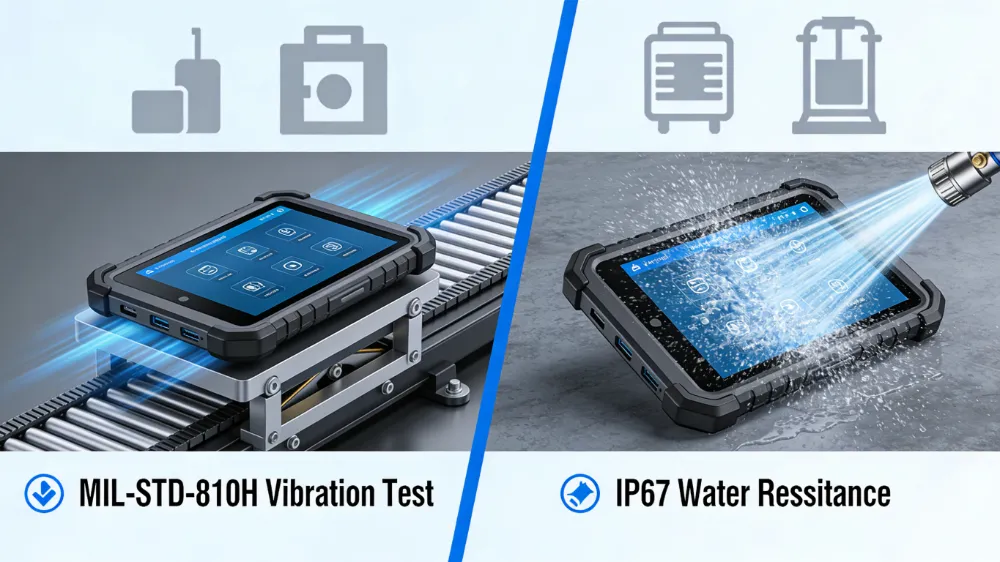
The most reliable indicator of ruggedness is compliance with MIL-STD-810H (or its predecessors MIL-STD-810G). This military testing standard encompasses a comprehensive suite of environmental tests. When evaluating tablets, verify compliance with these specific test methods:
| Test Category | MIL-STD-810H Method | What It Verifies |
|---|---|---|
| Vibration | Method 514.8 | Ability to withstand continuous vibration from vehicle operation |
| Mechanical Shock | Method 516.8 | Resistance to drops, bumps, and sudden impacts |
| Temperature | Methods 501.8, 502.8 | Operation in extreme heat (up to 140°F/60°C) and cold (down to -20°F/-29°C or lower) |
| Humidity | Method 507.6 | Resistance to moisture and condensation |
| Dust/Sand | Method 510.8 | Protection against fine particle ingress |
| Rain | Method 506.6 | Water resistance for exposed installations |
| Salt Fog | Method 509.8 | Corrosion resistance for coastal or winter-road operations |
For public safety and military applications, MIL-STD-810H compliance is non-negotiable. For logistics and field service applications operating in less extreme conditions, a subset of these tests may be acceptable.
2.2 IP Ratings: Ingress Protection Explained
The IP rating (Ingress Protection) defines a device’s resistance to solids and liquids. For vehicle-mounted applications, the minimum recommendation varies by use case:
- IP65: Protected against dust ingress and low-pressure water jets. Suitable for cab-mounted devices in typical logistics and service vehicles.
- IP67: Protected against dust ingress and temporary immersion in water up to 1 meter. Suitable for vehicles operating in wet conditions or where cab cleaning requires high-pressure washing.
- IP69K: Protected against dust ingress and high-pressure, high-temperature water jets. Required for vehicles in agriculture, food processing, or other environments requiring rigorous sanitation.
For public safety vehicle-mounted computer applications, IP65 or higher is standard. For military applications, IP67 is typically required.
2.3 Screen Technology: Sunlight Readability and Optical Bonding
The display is the primary interface between operator and device. In vehicle applications, screen performance under direct sunlight is critical.
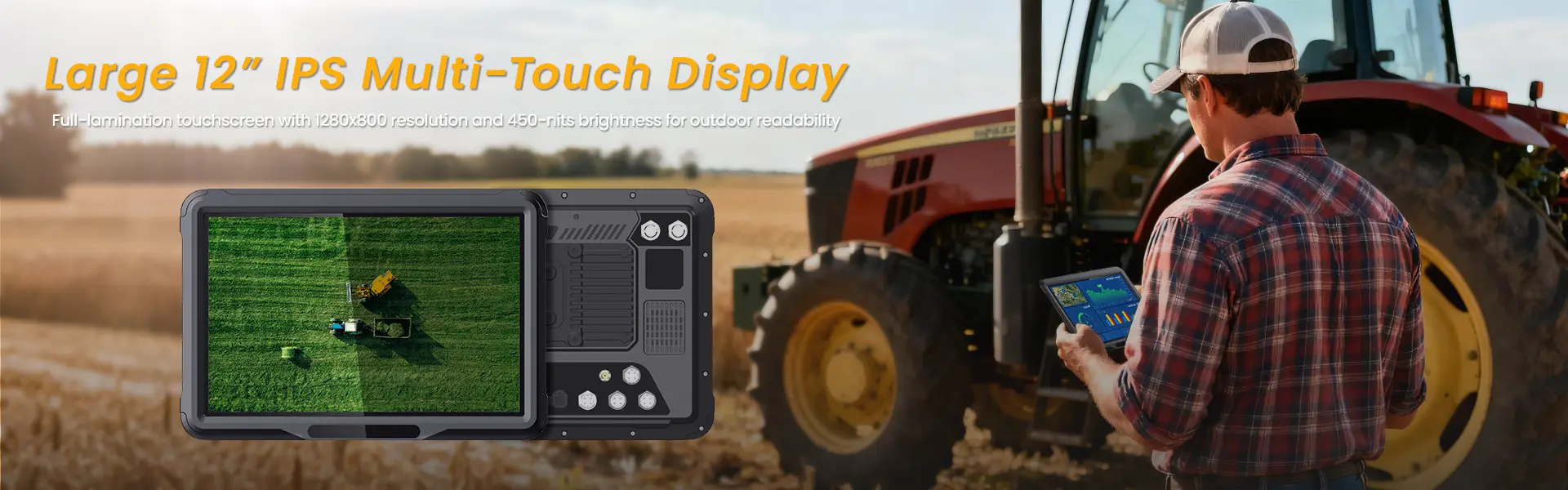
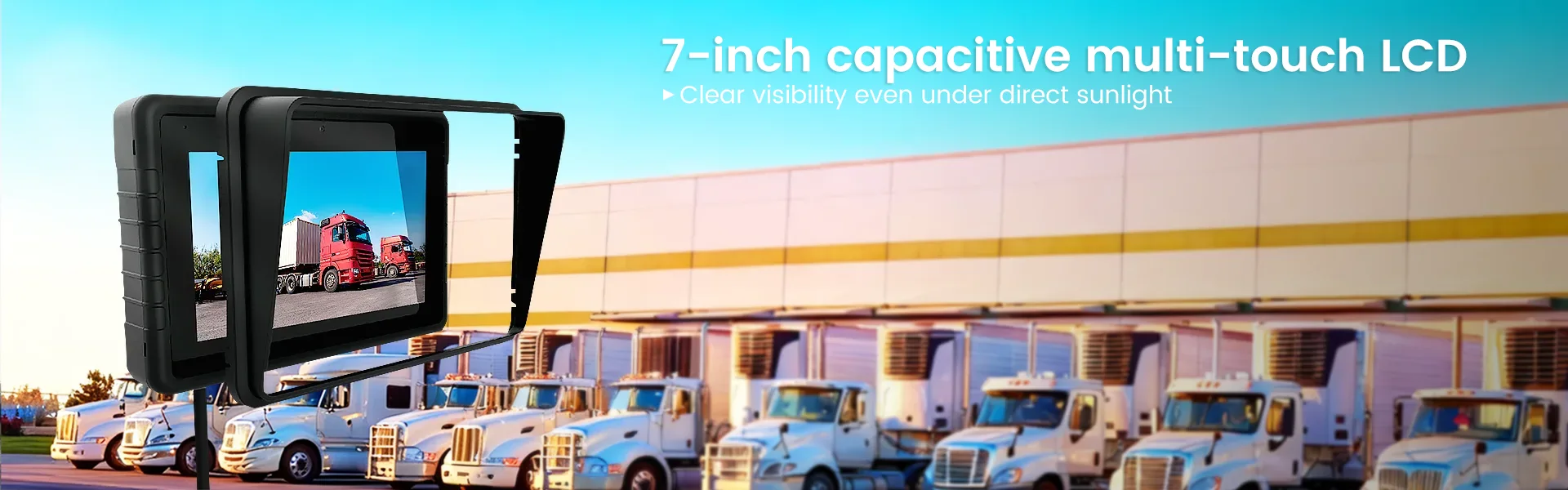
Sunlight Readable displays achieve sufficient brightness (typically 800 to 1,200 nits or higher) to remain visible in full sunlight. Consumer tablets typically offer 400 to 500 nits, which become unreadable in bright conditions.
Optical bonding is a manufacturing process that eliminates the air gap between the touchscreen and the display panel. Benefits include:
- Reduced glare and reflections
- Improved contrast and readability in bright light
- Enhanced durability and resistance to moisture ingress
- Better performance with polarized sunglasses compatible displays
For drivers and operators who wear polarized sunglasses—common in public safety, logistics, and field service—ensure the display maintains visibility when viewed through polarized lenses. Some manufacturers offer specialized display technologies to address this requirement.
2.4 Touchscreen Technology
Vehicle environments demand touchscreens that work reliably under challenging conditions:
- Projected Capacitive (PCAP): Multi-touch support, excellent optical clarity, works with gloved hands when configured appropriately. The standard choice for most applications.
- Resistive: Single-touch only, lower optical clarity, but works with any input (gloves, stylus, wet conditions). Preferred for applications requiring extreme glove compatibility or wet operation.
2.5 Cold Weather Performance
For fleets operating in northern climates or winter conditions, cold weather rugged vehicle tablet performance is a critical consideration. Key specifications include:
- Operating temperature range: Look for -20°F (-29°C) or lower minimum operating temperature
- Storage temperature: Even lower temperatures for when vehicles are parked
- Cold cranking capability: The ability to power on and operate when vehicle electrical systems are stressed during cold starts
- Heated displays: Some high-end devices incorporate display heating elements to prevent icing and maintain touch sensitivity
2.6 Power Management and Vehicle Integration
Vehicle-mounted tablets require sophisticated power management to operate reliably within vehicle electrical systems.
Ignition sensing allows the device to detect when the vehicle is running and manage power states accordingly. A properly configured ignition sensing system:
- Powers the device on when the ignition is engaged
- Maintains operation while the vehicle runs
- Initiates a graceful shutdown or sleep state when ignition is turned off
- Preserves vehicle battery by preventing parasitic drain
Reverse polarity protection prevents damage if the power connection is accidentally reversed during installation—a common installation error that destroys unprotected devices.
Power conditioning protects against voltage spikes, surges, and fluctuations common in vehicle electrical systems, particularly during engine start and alternator operation.
For organizations leveraging vehicle data, CAN bus integration enables the tablet to access vehicle telematics: engine diagnostics, speed, fuel consumption, and other operational data that can enhance fleet management and safety monitoring.
3. Mounting Solutions: Securing the Device
3.1 VESA Mount Standards
The VESA mount (Video Electronics Standards Association) is the industry standard for mounting displays and computing devices. Most rugged tablets and docks incorporate VESA-compliant mounting patterns, enabling compatibility with a wide range of mounting hardware.
Common VESA patterns for vehicle-mounted tablets include:
- 75mm x 75mm for smaller tablets
- 100mm x 100mm for larger displays and docks
3.2 RAM Mount Systems
RAM mount (Round-Arm-Mount) systems are the industry standard for vehicle mounting. These systems offer:
- Modular components (ball, socket, and arm) that adjust to any position
- Vibration-damping rubber balls that absorb road shock
- Compatibility across thousands of devices and vehicles
- Quick-release options for removable tablets
For public safety and military applications, RAM mounts provide the proven reliability required for emergency response vehicles.
3.3 Docking Station Configurations
The how to choose rugged vehicle-mounted tablets for fleet serves as the interface between the vehicle and a removable rugged tablet. A well-designed docking station provides:
- Secure retention: Holds the tablet firmly during vehicle operation
- Power delivery: Charges the tablet and provides continuous operation power
- Antenna connections: External GPS, cellular, and Wi-Fi antennas for improved signal
- I/O expansion: USB, Ethernet, serial, and other ports for peripheral connections
- Ignition sensing: Vehicle power state detection
- Locking mechanism: Prevents theft and unauthorized removal
For mixed-use deployments where tablets are shared across vehicles or shifts, docking stations enable hot-swappable configurations where a driver or officer can insert their assigned tablet into any vehicle and have immediate access to their applications and data.
3.4 Hot Swappable Battery Advantages
For organizations using removable tablets, hot swappable battery vehicle tablet advantages include:
- Continuous operation during battery replacement
- Extended shift coverage without vehicle downtime
- Redundancy for critical operations
- Reduced need for in-vehicle charging during operation
4. Integration Capabilities
4.1 GPS/GNSS Precision
For fleet operations, precise positioning is non-negotiable. GPS/GNSS integration must support:
- Multi-constellation support: GPS (United States), GLONASS (Russia), Galileo (Europe), BeiDou (China) for maximum availability and accuracy
- Differential GPS capability: For sub-meter or centimeter-level accuracy when required
- External antenna support: Vehicle-mounted roof antennas provide superior reception compared to internal device antennas
Telematics platforms rely on accurate positioning data for vehicle tracking, route optimization, and driver behavior monitoring. The rugged tablet serves as the collection point for this data, making GNSS quality a critical selection criterion.
4.2 CAN Bus Integration and Telematics
CAN bus integration enables the rugged vehicle tablet to access and display vehicle data:
- Engine diagnostics and fault codes
- Vehicle speed and RPM
- Fuel consumption and efficiency metrics
- Brake application and harsh event detection
- Seatbelt status and door ajar warnings
For fleet managers, this integration transforms the tablet from a simple navigation and dispatch tool into a comprehensive mobile resource management platform that captures both operator activity and vehicle performance.
4.3 Connectivity Options
Vehicle-mounted tablets must maintain reliable connectivity in varied environments:
- Cellular: 5G or 4G LTE with carrier aggregation for consistent connectivity
- Wi-Fi: Support for 802.11ax (Wi-Fi 6) for depot and yard connectivity
- Bluetooth: Version 5.0 or higher for peripheral connectivity
- Satellite: Optional satellite connectivity for remote area operations
- Dual SIM: Support for multiple carriers to maintain coverage across operating regions
Over-the-air update capabilities allow IT teams to deploy software updates, security patches, and configuration changes without recalling vehicles or requiring operator intervention.
4.4 Peripherals and Expansion
Field operations often require connectivity to external devices:
- Vehicle printers for tickets and receipts
- Barcode scanners for inventory management
- Backup cameras for safety and maneuverability
- Emergency lighting and siren controls (public safety)
- License plate readers (law enforcement)
Evaluate the tablet’s I/O capabilities: USB ports, serial ports (RS-232 for legacy devices), Ethernet, and auxiliary inputs for peripheral integration.
5. Use Case-Specific Considerations
5.1 Public Safety Vehicle-Mounted Computers
Police, fire, and EMS agencies have unique requirements beyond commercial fleets:
- Instant-on capability: Devices must be ready immediately upon vehicle startup
- Emergency lighting integration: Tablet should interface with vehicle warning systems
- CAD integration: Seamless connectivity with computer-aided dispatch systems
- Video integration: Support for in-car video systems and body-worn cameras
- Evidence-grade security: Encryption and chain-of-custody features for evidentiary data
Best rugged tablets for police vehicles are typically those with MIL-STD-810H compliance, IP65 or higher ratings, sunlight-readable displays, and comprehensive docking solutions that provide immediate power and connectivity.
5.2 Logistics and Transportation
For logistics fleets and GPS integrated rugged vehicle tablets for logistics, priorities include:
- Route optimization: Real-time navigation with traffic awareness
- Electronic logging device (ELD) compliance: Integration with hours-of-service regulations
- Proof of delivery: Signature capture and photographic documentation
- Trailer tracking: Visibility into trailer location and status
- Driver behavior monitoring: Harsh braking, acceleration, and cornering detection
5.3 Military Applications
Military-grade vehicle tablets demand the highest levels of durability and security:
- MIL-STD-810H full compliance across all test methods
- IP67 or higher water resistance
- TAA compliance for government procurement
- NSA-approved encryption for classified data
- Tactical radio integration for battlefield communications
- Night vision compatible displays
5.4 Field Service and Utilities
For utility crews and field service organizations:
- GIS mapping: Integration with geographic information systems
- Asset management: Access to infrastructure records and work orders
- Paperless work orders: Digital forms and documentation
- Augmented reality: Support for AR applications that overlay utility infrastructure data on camera views
5.5 Agriculture and Construction
Heavy equipment operators in agriculture and construction require:
- IP69K ratings for high-pressure washdown
- Vibration resistance for off-road operation
- CAN bus integration for equipment telematics
- Machine control compatibility for precision operations
6. The Business Case: Cost Analysis and ROI
6.1 Total Cost of Ownership
When evaluating rugged vehicle tablets, focusing solely on purchase price leads to poor decisions. Cost of rugged in-vehicle tablet systems per unit typically ranges from $1,500 to $4,000 depending on specifications. However, total cost of ownership (TCO) over a three- to five-year lifecycle includes:
| Cost Component | Typical Range |
|---|---|
| Hardware purchase | $1,500 – $4,000 per unit |
| Mounting and docking | $200 – $600 per vehicle |
| Installation labor | $150 – $400 per vehicle |
| Annual maintenance/support | $150 – $300 per device |
| Replacement frequency | Consumer: 12-18 months; Rugged: 3-5 years |
6.2 ROI Drivers
The return on investment for rugged vehicle tablets comes from multiple sources:
Reduced Replacement Costs
Consumer tablets deployed in vehicles often fail within 12 to 18 months. Rugged tablets typically provide 3 to 5 years of reliable service, reducing replacement frequency by 50% to 70%.
Improved Operator Productivity
Field personnel spend less time waiting for slow or failing devices, dealing with charging issues, or troubleshooting connectivity problems. Productivity gains of 10% to 20% are commonly reported after ruggedization programs.
Reduced Downtime
Vehicle downtime for IT issues is minimized. Fleet availability improves, and service levels become more predictable.
Enhanced Safety
Reliable in-vehicle computing enables safety features such as backup camera integration, driver coaching, and hands-free operation that reduce accident rates and associated costs.
Data-Driven Operations
Consistent, reliable telematics data enables route optimization, fuel efficiency improvements, and driver behavior coaching that yield ongoing operational savings.
6.3 Procurement Considerations
For government and public safety procurement, TAA compliance (Trade Agreements Act) may be required for federally funded purchases. TAA-compliant products are manufactured or substantially transformed in the United States or other approved countries.
7. Testing and Validation
7.1 Vibration Testing Standards
Vehicle-mounted tablet vibration testing standards go beyond MIL-STD-810H for vehicle applications. Specific considerations include:
- Random vibration profiles that simulate real-world road conditions
- Resonant frequency testing to identify potential failure points
- Endurance testing across multiple axes (X, Y, Z)
- Operational testing during vibration to ensure functionality
Reputable manufacturers provide detailed test reports rather than simply claiming compliance.
7.2 Field Validation
Before committing to a large-scale deployment, conduct field validation:
- Select a small pilot group (5 to 10 vehicles)
- Deploy in actual operating conditions for 60 to 90 days
- Gather operator feedback on usability, reliability, and functionality
- Monitor IT support tickets for issues
- Track any failures and their root causes
8. Future Trends in In-Vehicle Computing
8.1 Edge AI and Computer Vision
Vehicle-mounted tablets are increasingly incorporating edge AI capabilities for real-time video analysis: driver distraction detection, obstacle recognition, and automated incident recording.
8.2 5G and Advanced Connectivity
5G connectivity enables higher bandwidth for video streaming, real-time telematics, and over-the-air updates. Dual-carrier 5G configurations provide redundancy for critical operations.
8.3 Augmented Reality Integration
AR applications overlaying navigation directions, asset locations, or hazard warnings on camera views are emerging as valuable tools for logistics and field service operations.
8.4 Vehicle-to-Everything (V2X) Integration
Emerging V2X standards will enable tablets to communicate with traffic infrastructure, other vehicles, and pedestrian devices for enhanced safety and efficiency.
8.5 Sustainable Design
Manufacturers are increasingly focusing on energy efficiency, recyclable materials, and reduced hazardous substances in compliance with RoHS and other environmental standards.
Conclusion: A Framework for Selection
Selecting the right rugged vehicle-mounted tablet requires a systematic approach:
- Define your operating environment: Temperature extremes, vibration exposure, moisture and dust conditions, cleaning protocols
- Identify required certifications: MIL-STD-810H, IP rating, TAA compliance
- Determine form factor: Permanent mount vs. removable tablet, screen size requirements
- Evaluate mounting and docking: VESA compatibility, RAM mount integration, docking station features
- Assess integration needs: CAN bus, telematics, peripheral support, connectivity requirements
- Consider power management: Ignition sensing, hot swappable battery advantages, power conditioning
- Calculate total cost of ownership: Purchase price plus installation, maintenance, and replacement costs over expected lifecycle
- Conduct field validation: Pilot deployment before large-scale rollout
The organizations that succeed in mobile operations are those that recognize the rugged vehicle-mounted tablet not as a commodity purchase but as a strategic investment in operational reliability, operator safety, and data-driven efficiency.
Resources and References
- MIL-STD-810H: Environmental Engineering Considerations and Laboratory Tests
- IEC 60529: Degrees of Protection Provided by Enclosures (IP Code)
- Federal Motor Carrier Safety Administration: Electronic Logging Device Requirements
- National Institute of Justice: In-Vehicle Computing System Standards
相关推荐内容
Latest Content
- Mining Tablet Guide: Rugged, Reliable Tablets for Harsh Mining Environments
- 1000 Nits Brightness Rugged Tablet: The Essential Field Companion for Outdoor Conditions
- Rugged Tablets for Fleet Management: Enhance Efficiency and Durability
- Industrial Tablet Manufacturer: Durable Solutions for Harsh Environments
- Can Rugged Tablets for Forklifts Really Transform Material Handling Efficiency and Durability?
Hot product
- WMT6UQ: 6-Inch 4G Android 12 Wireless Carplay Navigator Motorcycle PND
- WT10RX: 10.1 inch rugged tablet,10.1″ sunlight-readable display,10.1" ip67 rugged tablet
- WT10MX: 10.1 inch rugged tablet 12,000 mAh,10.1″ IPS display Rugged IP65 design
- WT08Q9Y: 8 inch 10000mAh long battery rugged tablet,1000-nit rugged tablet,
- WT08M8Y: 8 inch Android 14,700-nits rugged tablet